
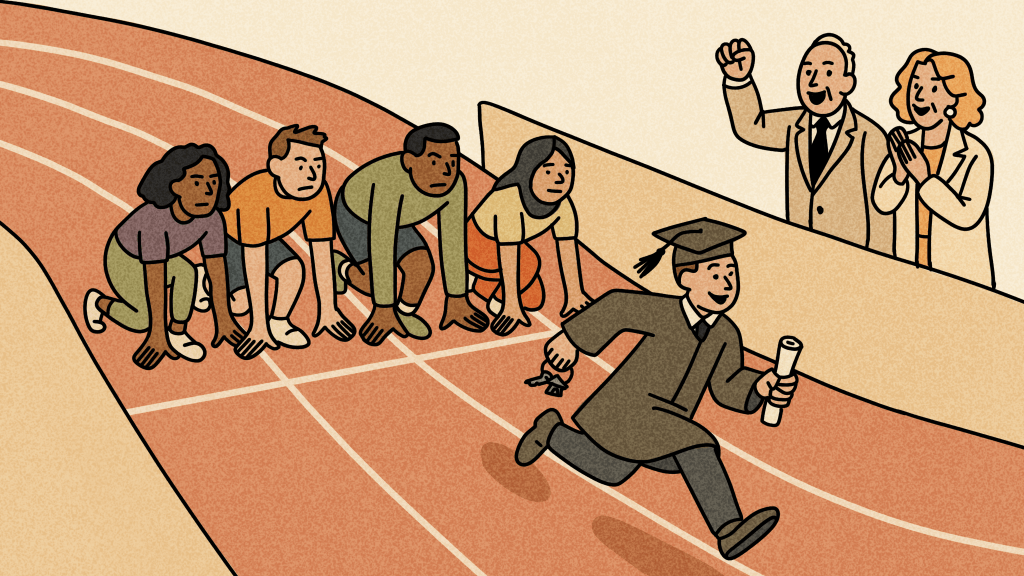
While doing research for this reflection, I came across the idea of ‘Scaffolding’. The idea is that some of us get to start life – or move through life – with certain Scaffolding in place that makes it easier for us to achieve success or navigate any difficulties that may come our way. This Scaffolding may look like:
- Emotionally supportive parents or a supportive partner
- Generational wealth, financial stability, and inheritance
- Social connections that can offer access to better opportunities
- Support for gaining a higher education
- Family who can help with childcare or the associated costs
- Family who can help with housing needs or a deposit for a house
- Basic needs for food, housing, and financial security being met
- A supportive friendship group, village, or community
There’s a story many of us are told — implicitly or explicitly — that if we just work hard enough, stay focused, and never give up, then we can succeed. This is the myth of the level playing field: the idea that everyone starts life with the same level of opportunities, and that success is only a matter of effort.
But many of us know, often painfully, that this simply isn’t true – the Scaffolding just isn’t there.
Whether it’s growing up without financial support, surviving trauma and abuse, navigating life in a new country, or raising children without a co-parent, these layers of complexity shape how we move through the world — and how the world responds to us. For those from marginalised backgrounds, the idea of a level playing field can feel not just inaccurate, but deeply invalidating and unjust.
As a trainee counsellor, I witness people who carry the weight of these inequalities daily. People who feel low because they’re struggling to pay the rent, or put food on the table, or get out of bed because of the pressures they’re feeling. People who wonder why they feel so tired all the time, not realising that what they’ve been carrying alone would exhaust anyone. And people who are only just beginning to name the scaffolding that was never there — and how that has shaped their sense of self-worth and their access to opportunities.
In therapy, we make room for these truths.
We examine the internal stories we tell ourselves — stories that say we’re behind, not good enough, or failing — and we ask, “Whose standards are these?” and “Where did they come from?”. We look at the roles privilege and systemic inequality have played in shaping our beliefs and our possibilities. And we begin to see that personal growth and self-compassion cannot be separated from the social and cultural contexts we’re in.
Counselling doesn’t erase inequality, but it can give us space to name it and hold it. To say: This is the truth of where I’ve come from. And I deserve care, healing, and understanding — not in spite of it, but because of it.
Because once we stop blaming ourselves for a race that was never fair, we can begin to see our own individual path more clearly. One shaped not by comparison, but by personal meaning and purpose.
 Nikita Nielsen
Leave a comment